This interview was made by ADAM IVY from ivybetty.com and translated in english by Rachel Thomas. Thanks to both of them.
AI: I find myself obsessed with perfection. I am fascinated by it and how perfection, just like beauty, comes in so many forms, and from so many different approaches. That brings me to you; your “less is more” approach to artwork is extremely refreshing in the sense that you don’t define the perfection for us. It’s as if you set the outline and allow the audience to fill it in with their own sense or perception of perfection. Has this always been your approach, and what brought you to this style of creation?
LR: It is true that everyone has their own definition of perfection. I think I can find many different styles “perfect” in painting and anything else in life. Basically, I started to paint in order to do a “good” painting. I tried hard to finish these paintings, but never managed to. I always thought there was something wrong and often were sorry I had gone so far. I would think to myself, “It was better at that stage of the painting.”
That’s when you wonder if it’s more interesting to do nothing than to do just average stuff. But then I was concerned about people’s opinion; they would think I didn’t care about them by just drafting a painting. Now I have decided not to be influenced by the gaze of others. But then imagine an architect who decides to stop at the foundation of a large house … It doesn’t seem right, at first, but still is interesting to see. Especially if it is a classic house. It would interest me more.
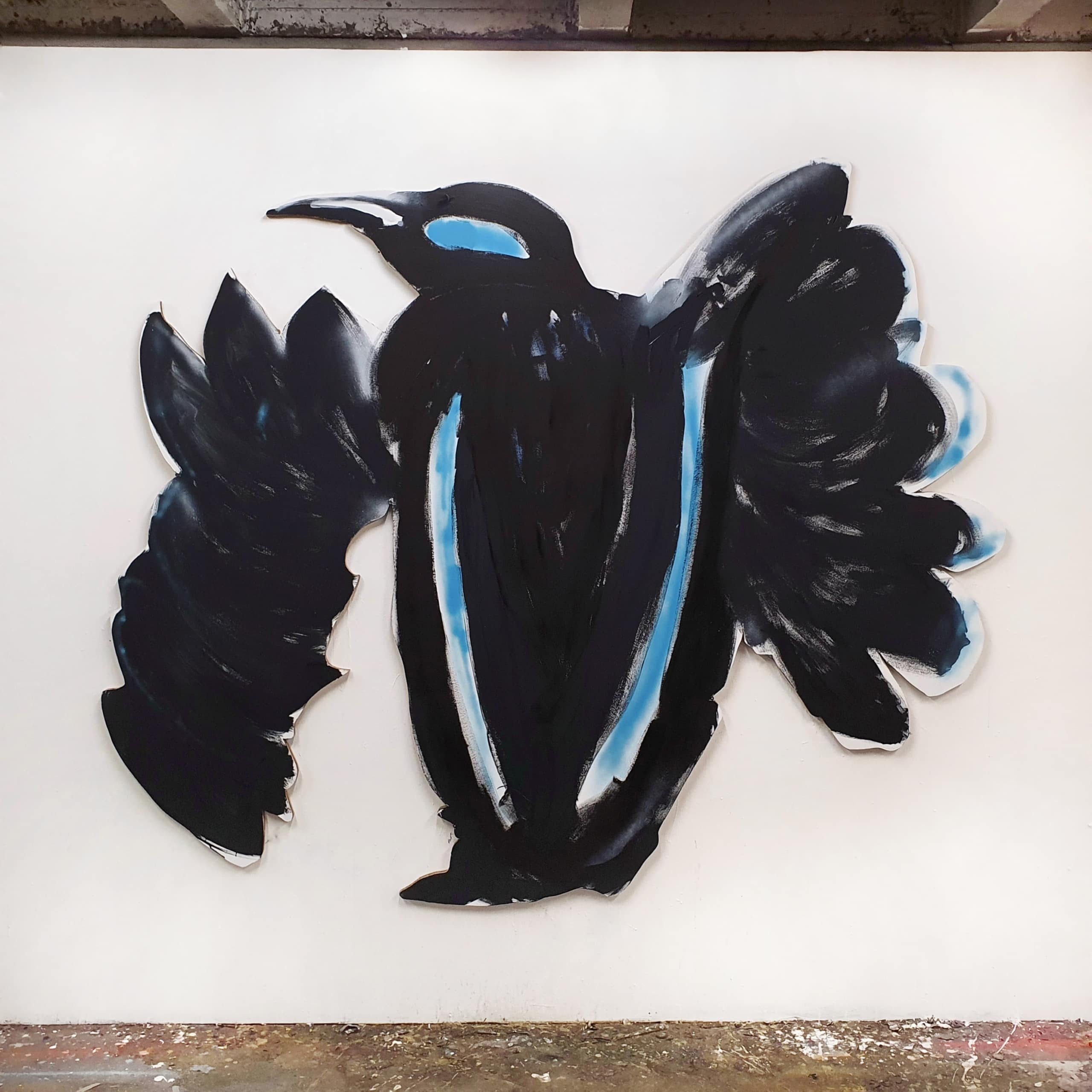
For some people no doubt, my paintings are easy or even weak, because I give up when things get complicated. I see it more as a search. As I often say, “I let the viewer imagine their own end.”
And then there’s the lassitude of finishing things. I like this quote from John Baldessari,
“It is only when you have been painting for quite some time that you will realize that to begin your compositions seem to lack impact – That they are too ordinary. That is when you will start to break all the rules of so-called composition and to think in terms of design. Then you can distort shapes, forms invent, and be on your way towards being a creative artist.”
So basically, I’m more interested in a search of freedom and strength in an unfinished painting than the perfection of a well-finished canvas, which only shows technical prowess.
AI: I am interested to know how you define the word create? Is there a such thing as being finished, and do you believe that mistakes and creation can coexist?
LR: I am not sure about about the word “create.” We can agree on a lot of different things; I don’t want to dwell on that particular word. All I can say is that to start with, I created because I was bored. To me it is boredom that makes you creative. I think If my life was too full I wouldn’t create anything.
In terms of finishing, it is over when I feel it is. Sometimes it’s very early in the creative process, sometimes I want to show more things. Each work has its limits that I often exceed and destroy when there is too much for my taste. I don’t like to finish my sandwich or my plate. It’s a bad habit that I’ve had since I was little.
I think errors and creation are inextricably linked, perhaps some artists have already worked on the error. I think I am more attracted to a failed or shaky line rather than a straight one which bores me.
AI: True artists find the smallest nuances or corners of human nature that are often overlooked and expand upon them in a way that highlights and exposes them to the naked eye of the average person. I notice this in your work quite often, especially in the Adopte Un Mec series. Tell our readers a little about what inspired those particular paintings.
I tend to criticize all too well my own work, I’m not really a good salesman. I would tend to talk about all that’s wrong in my paintings rather than the good parts
For the series Adopte Un Mec, I first thought about Facebook profile pictures, where we often don’t look like what we really are. Again this is a random selection of photos. I just asked myself in which environment would this be even more pronounced than on a social network profile.
Where do you have to be attractive? Where the image we send out is the first criteria ? On a dating site. In addition to finding interesting photos at the beginning, I realized that these people would show the photos they think they look the best in, at all costs. Ending up having a picturesque photo. It attracted me. It is a kind of criticism that amuses me and allows me to make painted images that aren’t ordinary.
AI: What is your favorite element of human character? For example, I currently examine pride/ego and how it affects people’s decisions and actions. I find it very interesting to study this not only in myself, but those very close to me as well. So again I ask is there an element of character/human nature that really intrigues you personally/artistically?
LR: I like people who are able to play with their intelligence and can make fun of it. Being able to not care about a lot but also being able to do things thoroughly. Artistically, I agree slightly to that too. I also admire people who do very audacious things I wouldn’t have dared to do.
AI: Much of your work involves faces. When you are creating these works are you conscious of trying to capture an emotion or expression? Or are your efforts more focused on creating an abstract visual effect around the face?
LR: At the beginning, because my work is mainly based from photos, it is a selection similar to that of a photographer, capturing a moment, an emotion, something… The transition to painting, transforms this thing again as I see it or how I feel it. I build each painting slowly in my head, quickly on the canvas, but with many short breaks to think about the result… is this enough? I de-structure faces, because in my eyes, reproducing a photograph with no particular change isn’t interesting. But I repeat, that is just my own opinion.
AI: The Corps&Graphiquement is my favorite of all your work because of its origin in the blending of two different expressions of art. Is there another form of art that inspires you as much as choreography does?
LR: There are several. I would like to paint movie scenes. It’s something that I think I’ll do later, for example with Elem Klimov’s “Come and see.” Installations also attract me, as long as a construction is well done, I am interested in this form of expression. My interest in other forms of art is quite broad.
AI: Obviously your artwork is a form of expression for yourself, but how have you seen your work affect others around you? Does the effect it has on other people influence your creative process in any way?
LR: I’m pretty ill at ease with compliments, and criticisms annoy me pretty quickly. In any case feedback affects me a lot, that’s why I do not like openings, which I avoid as much as possible … When I listen to my relatives, I don’t often change, but I consider their criticism much more than that of a blog, or anywhere else.
AI: To follow up on the previous question, what would you like your audience to take away from your work?
LR: Maybe just a feeling. Everyone has their own vision of what’s right and wrong, so I’m quite satisfied when people understand that I take my research very seriously.
AI: What can we expect from you in the near future?
LR: I have several series in mind, at least a few years of production work ahead. I work too slowly. I would like to work more and be less lazy. I’ll have a proper studio soon, maybe this will change. I’m working on a medium other than canvas and paint.